
EV charger installation: what it costs and how it works

The Short Answer
A standard installation of a 7kW smart charger costs about £900 to £1,300 including VAT, on our estimates. That covers the charger, up to about 10 metres of cable, its protection, testing and the paperwork.
Anywhere in the UK, if you have an eligible electric car, renters and flat owners with their own off-street space can get a government grant of up to £500, and so can homes with only on-street parking that fit a cross-pavement channel. If you own and live in a house with its own parking space, there's no grant in England, Wales or Northern Ireland (landlords have a grant of their own). In Scotland, rural and remote households with an electric car (or one on the way) and a household income of £50,000 or less can get up to £400.
Get a free quote below and a local installer will be in touch.
What a home charger installation costs
On our estimates a standard installation costs £900 to £1,300, VAT included. Here's what we count as standard, so you can check a quote against it:
- a 7kW smart charger, with the cable attached or a socket for your own;
- fitted to an outside wall of the house or garage;
- up to about 10 metres of cable from your consumer unit, clipped to the walls, with one hole through the wall;
- its own protection (an RCD or RCBO) in your consumer unit or a small separate unit;
- the earthing checked, with an earth rod if your installer's checks call for one;
- testing, the certificates, telling the network operator, and setting up the app.
When we checked in November 2026, fixed-price packages that include a standard installation cost £909 to £1,299 at BOXT, £1,029 to £1,269 at Octopus Energy, and up to £1,296 at E.ON Next (an Ohme Home Pro, for new customers). Our range is built on packages like these, because they say exactly what their standard installation covers (between 5 and 15 metres of cable, depending on the supplier): the cheapest sets the bottom of our range, and the middle of their top prices sets the top. The charger moves the price most: BOXT's ran from £909 to £1,299 with the same standard installation, depending on the charger.
A real quote, line by line
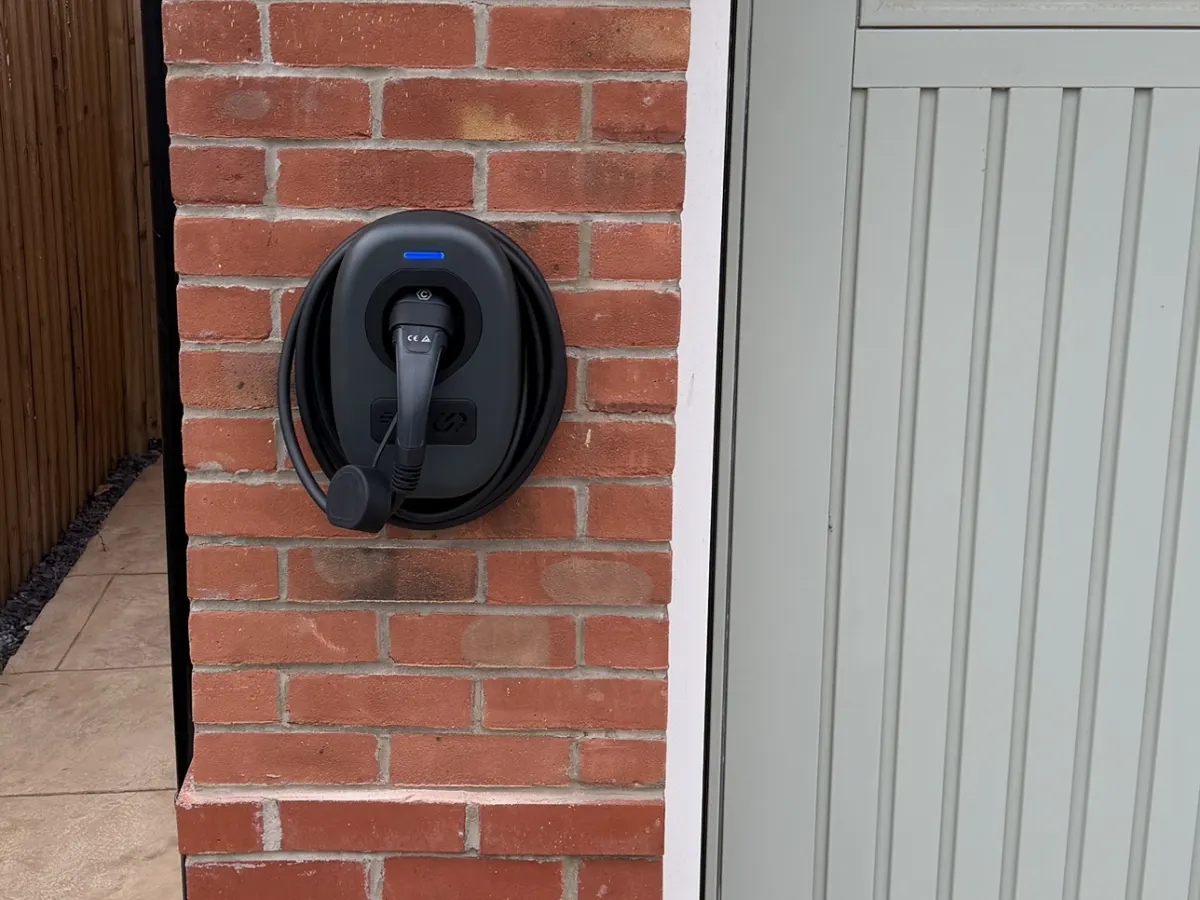
This is the quote Gavin Rogers, who wrote this page, accepted for his own charger at home in North Wales in November 2026, with the installer's name left out: a 7.4kW Sync Energy tethered charger on the garage pillar, with its own small consumer unit in the garage.
| Item | Price |
|---|---|
| 7.4kW Sync Energy tethered charger | £479.99 |
| EV board (a separate small consumer unit for the charger) | £104.68 |
| Meter tails (pack) | £30.00 |
| Henley blocks (3) | £21.84 |
| 6mm cable | £59.99 |
| Fire-rated cable clips | £9.80 |
| Labour | £325.00 |
| Total | £1,031.30 |
It came to £1,031.30: £479.99 for the charger, £226.31 for the parts to connect it, and £325.00 for the labour. Two things on it are worth checking on any quote you get: it asked for a 50% non-refundable deposit to book the date, and the price was only valid for 7 days. It also showed no VAT line, so if a quote doesn't say, ask whether VAT is included.
What can add to the price
Some homes need more than a standard installation. These are our estimates for the usual extras, VAT included:
| Extra | Our estimate | When you need it |
|---|---|---|
| A longer cable run | £100 to £400 | The charger is more than about 10 metres from your consumer unit |
| A trench to the drive or an outbuilding | £300 to £1,000 | The cable has to go underground, to a drive or outbuilding (it depends on the length and the surface) |
| A new consumer unit | £500 to £900 | Your fuse box can't take another circuit safely |
| A cross-pavement channel | Not in our estimate | You park on the street and the cable has to cross the pavement (see charging without a driveway) |
| A bigger main fuse, or unlooping | Usually free in Great Britain | The network operator does it; usually free for a typical household supply (up to 23kVA) |
A bigger main fuse or unlooping is the network operator's job, not your installer's. In Great Britain it's usually free for a typical household supply (up to 23kVA); extra work you ask for, such as moving the supply, can be charged, and the network operator tells you before any work goes ahead. In Northern Ireland, ask your installer whether there's a charge.
Estimate your installation
Starts from a standard installation (£900 to £1,300, up to about 10 metres of cable). Add anything your home needs.
Our estimate for your installation: £900 to £1,300, including VAT.
In Great Britain the network operator's work (a bigger main fuse or unlooping) is usually free for a typical household supply, so it isn't in this figure; in Northern Ireland, ask your installer. A survey sets the real price; this is our estimate to check quotes against.
Grants: who can get one
The government's grant pays 75% of the cost of buying and installing a charger socket, up to £500. It rose from £350 on 1 April 2026, and runs until 31 March 2027, according to GOV.UK. There are two grants for households, both available anywhere in the UK (landlords have their own):
- Renters and flat owners: you live in a flat you own or rent any home, you have your own private off-street parking space, and you own or use an eligible electric car.
- On-street parking only: you own or rent your home, have no private off-street parking but adequate on-street parking, own or are responsible for an eligible electric car, and fit a permanent cross-pavement solution, with permission from your highways authority. See charging without a driveway.
You can't get the renters and flat owners grant if you own and live in a house (unless it's been converted into flats and you live in one of them). Don't have the charger fitted before OZEV tells you you're eligible: when we checked, OZEV estimated up to 10 working days to assess an application. Your installer must be OZEV-approved, and takes the grant off your invoice; GOV.UK has a postcode search for approved installers.
Scotland: the Energy Saving Trust offers up to £400 if you live in a rural or remote area, have an electric car (or will soon), and your household income is £50,000 or less. It uses the Scottish Government's urban rural classes 5 to 8, and its page has a postcode checker, so check your postcode rather than guess. It aims to decide within 8 working days, you mustn't start the installation before the offer letter, and the fund is first come, first served and may close without notice, according to the Energy Saving Trust.
More on each grant: EV charger grants.
How installation works, step by step
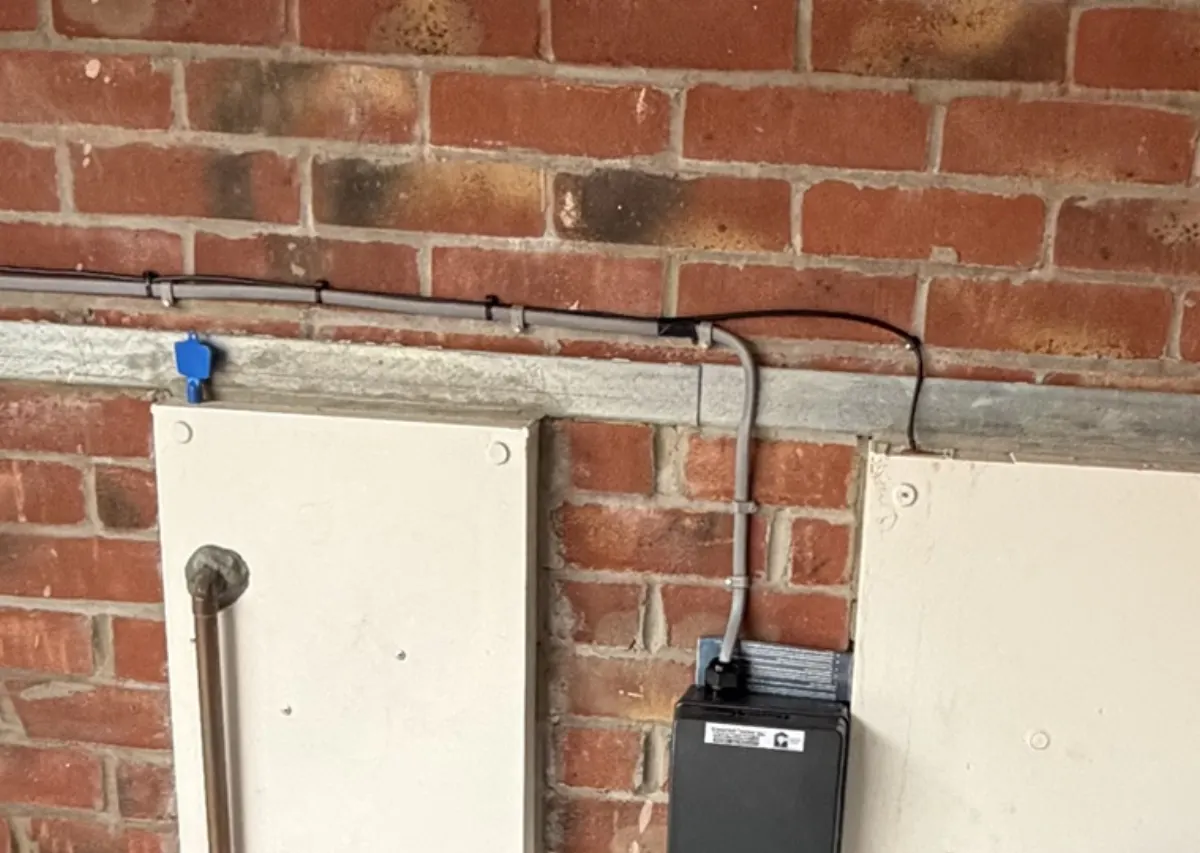
- 01Quote and surveyExpect to be asked for photos of your consumer unit, electricity meter and where you park, or for a survey visit. That's how the installer spots extras before quoting.
- 02Grant approval, if you're claiming oneWait for the grant to be approved before anything is fitted: by OZEV for the UK grants, or by the Energy Saving Trust for Scotland's rural grant.
- 03The network operatorYour installer works out your home's maximum demand with the charger added. At SSEN, for example, if it's 60 amps or less, there are no safety concerns and it meets SSEN's other criteria, the installer can fit the charger and notify SSEN within 28 days; above that, or if your supply is looped (shared with a neighbour), they apply first and wait for approval. If your supply needs a bigger main fuse or unlooping, in Great Britain the network operator usually does it free for a typical household supply (up to 23kVA).
- 04Installation dayOn our estimate a standard installation takes about half a day. The installer checks your earthing and bonding, fits the charger and its protection, runs the cable, tests everything and sets up the app with you.
- 05The paperworkIn England a new circuit is notifiable building work. An installer registered with a competent person scheme certifies it themselves and must give you a copy of the building regulations certificate within 30 days of finishing; otherwise building control has to be notified before the work starts, at least 2 days ahead. Ask for the electrical installation certificate too.
These are the building rules in England. Elsewhere in the UK, ask your installer how they'll certify the work. Who's allowed to fit a charger, and why we'd leave it to an electrician: who can install an EV charger.
Do you need planning permission?
In England, usually not. A charger mounted on a wall in a parking area, or anywhere else within the grounds of a house or block of flats, is permitted development within these limits, under the planning rules that changed on 21 October 2026. You'd need permission if:
- the charger and its casing are bigger than 0.2 cubic metres, or it's mounted more than 1.6 metres above the ground;
- it's within the grounds of a listed building, or on a scheduled monument;
- it's outside a parking area and would be a second charger, or would be outside a parking area in a conservation area;
- it's on a wall next to a road and would stick out more than 0.2 metres, or leave less than 1.5 metres of footway.
If the cable has to cross a pavement, it must use an authorised cross-pavement solution. Elsewhere in the UK, check with your council before you book.
Choosing the charger
In Great Britain a business can only sell a home charger (other than a plain charging cable) that meets the smart charging rules, which came in on 30 June 2022, with their security requirements added from 30 December 2022. So the real choices are the brand, the app, the power and whether the cable is attached.
- Tethered: the cable is fixed to the charger. Nothing to carry around.
- Untethered: a socket only, so you plug in your own cable, and you can use the same cable at public chargers that don't have one attached. If you need one, see our Type 2 charging cables.
Going untethered?
You'll need a charging cable that fits your car. Pick one from our shop.
What a good quote should tell you
Before you say yes, check the quote covers:
- the charger model, and whether the cable is attached;
- how much cable is included, and the price for anything beyond it;
- the protection (RCD or RCBO), and whether an earth rod is included if you need one;
- who tells the network operator, and what happens if your supply is looped;
- which certificates you'll get, and when;
- the deposit, whether it's refundable, how long the price holds, and whether VAT is included;
- if you're claiming a grant, that the installer is OZEV-approved and won't fit anything until you're approved.
How our quotes work
When you ask for a quote here, your details go to our quotes partner, which passes your job to local installers, and a local installer can then get in touch to arrange the quote. It's free, and you don't have to go ahead.
Our partner asks electricians for proof they're allowed to do the work, but it also tells homeowners to check for themselves, and so do we. Before you book:
- in England and Wales, look the electrician up on the Electrical Competent Person Register. In England, an electrician registered with a competent person scheme can certify their own work under the building regulations;
- if you're claiming the government (OZEV) grant, check they're on GOV.UK's list of OZEV-approved installers, because the grant is only paid through one. For Scotland's rural grant, the installer has to be eligible with the Energy Saving Trust as well.
Common questions
Get a free installation quote
Tell us a little about your home and where you park, and a local installer will be in touch with a free quote. No obligation.
How we checked this
Every figure and rule on this page was checked against its source on 13 November 2026. We recheck them every month.
- Electric vehicle chargepoint grants (GOV.UK (OZEV), official; read 14 November 2026)
- Changes to electric vehicle chargepoint grant schemes from 1 April 2026 (GOV.UK (OZEV), official; read 14 November 2026)
- Electric vehicle chargepoint grant for renters or flat owners (GOV.UK, official; read 14 November 2026)
- Electric Vehicle Chargepoint Grant for Households with On-Street Parking (GOV.UK Find a grant, official; read 14 November 2026)
- OZEV home and workplace grants terms and conditions (GOV.UK (OZEV), official; read 13 November 2026)
- Looped Service (SSEN (Scottish and Southern Electricity Networks), official; read 13 November 2026)
- Find an electric vehicle (EV) chargepoint installer (GOV.UK, official; read 14 November 2026)
- Building regulations approval: use a competent person scheme (GOV.UK, official; read 13 November 2026)
- Registered Competent Person Electrical: find or check an electrician (Electrical Competent Person Register, official; read 13 November 2026)
- Domestic charge point funding (Scotland) (Energy Saving Trust for Transport Scotland, official; read 14 November 2026)
- Domestic Charge Point Grant 2026-2027 Eligibility Criteria (PDF) (Energy Saving Trust for Transport Scotland, official; read 13 November 2026)
- The Electric Vehicles (Smart Charge Points) Regulations 2021, regulation 1: extent (England and Wales and Scotland) (legislation.gov.uk, official; read 13 November 2026)
- The Electric Vehicles (Smart Charge Points) Regulations 2021, regulation 3: application (legislation.gov.uk, official; read 13 November 2026)
- The Electric Vehicles (Smart Charge Points) Regulations 2021, regulation 4: sale of charge points (legislation.gov.uk, official; read 13 November 2026)
- The Building Regulations 2010, regulation 12(6A): notifiable electrical work (England) (legislation.gov.uk, official; read 13 November 2026)
- The Building Regulations 2010, regulation 16: notice before starting work (England) (legislation.gov.uk, official; read 13 November 2026)
- The Building Regulations 2010, regulation 20: self-certification schemes (England) (legislation.gov.uk, official; read 13 November 2026)
- The Town and Country Planning (General Permitted Development) (England) Order 2015, Schedule 2 Part 2 Class D, as amended 21 October 2026 (legislation.gov.uk, official; read 14 November 2026)
- EV Connections (SSEN (Scottish and Southern Electricity Networks), official; read 13 November 2026)
- Connecting electric vehicles and heat pumps to the networks (Energy Networks Association, official; read 13 November 2026)
- Connecting electric vehicle chargepoints to the electricity network (GOV.UK (DESNZ), official; read 14 November 2026)
- Removing the distributor's cut-out fuse (Wiring Matters, July 2025) (IET, official; read 13 November 2026)
- Electric vehicle (EV) charger installation and maintenance (NICEIC, official; read 13 November 2026)
- EV chargers with installation (BOXT, industry; read 13 November 2026)
- EV chargers with installation (Octopus Energy, industry; read 13 November 2026)
- EV home charger installation FAQs (Octopus Energy, industry; read 14 November 2026)
- Home EV chargers with installation (E.ON Next, industry; read 14 November 2026)
Gavin Rogers
Director · Drives a BMW iX2
Gavin co-founded Power EV alongside EV Charge Cable, a specialist EV charging cable retailer. Between the two sites, the team covers the full home-charging picture: finding a qualified installer and getting the right cable to go with the charger.
Meet the team