
How to charge an electric car

The Short Answer
Plug the charger's cable into your car, start the charge (at home it starts on its own or on a schedule; at a public charger you tap a bank card or use an app), and unplug when you're done.
If you have a driveway, we'd fit a home charger and charge overnight on an EV tariff: from 6.5p per kWh, against 82p on an average public rapid charger. Without one, charge at work or at public chargers near home, and use rapid chargers on long journeys, stopping at about 80%.
Your charging plan
A few questions, then the way we'd charge, how long the car would be plugged in each week, and what it costs.
We'd charge at home, overnight, on a home charger and an EV tariff. Your 150 miles a week is about 50 minutes a day on a 7.4kW charger, inside the tariff's 6 cheap hours.
A 3-pin plug could keep up too: about 2 hours 40 minutes a night. It's fine for low miles or a backup, but Electrical Safety First advises avoiding standard sockets for charging.
| Way to charge | Plugged in a week | Cost a week |
|---|---|---|
| Home charger, 7.4kW (EV tariff, from 6.5p) | 5 hours 47 minutes | £2.79 |
| 3-pin plug, 2.3kW (price cap, 26.32p) | 18 hours 38 minutes | £11.28 |
| Public slower charger, 7kW (October 2026 average under 50kW, 54p) | 6 hours 7 minutes | £23.14 |
| Public rapid charger, 50kW (October 2026 average, 82p) | 51 minutes | £35.14 |
About 43kWh a week. Times and costs are for the energy the battery takes in, at each charger's full power. Allow a little more of both: some energy is lost as heat while charging, many cars charge slower, and rapid charging slows down above 80%. The EV tariff rate is its lowest, for up to 6 hours every 24 hours.
Charging at home
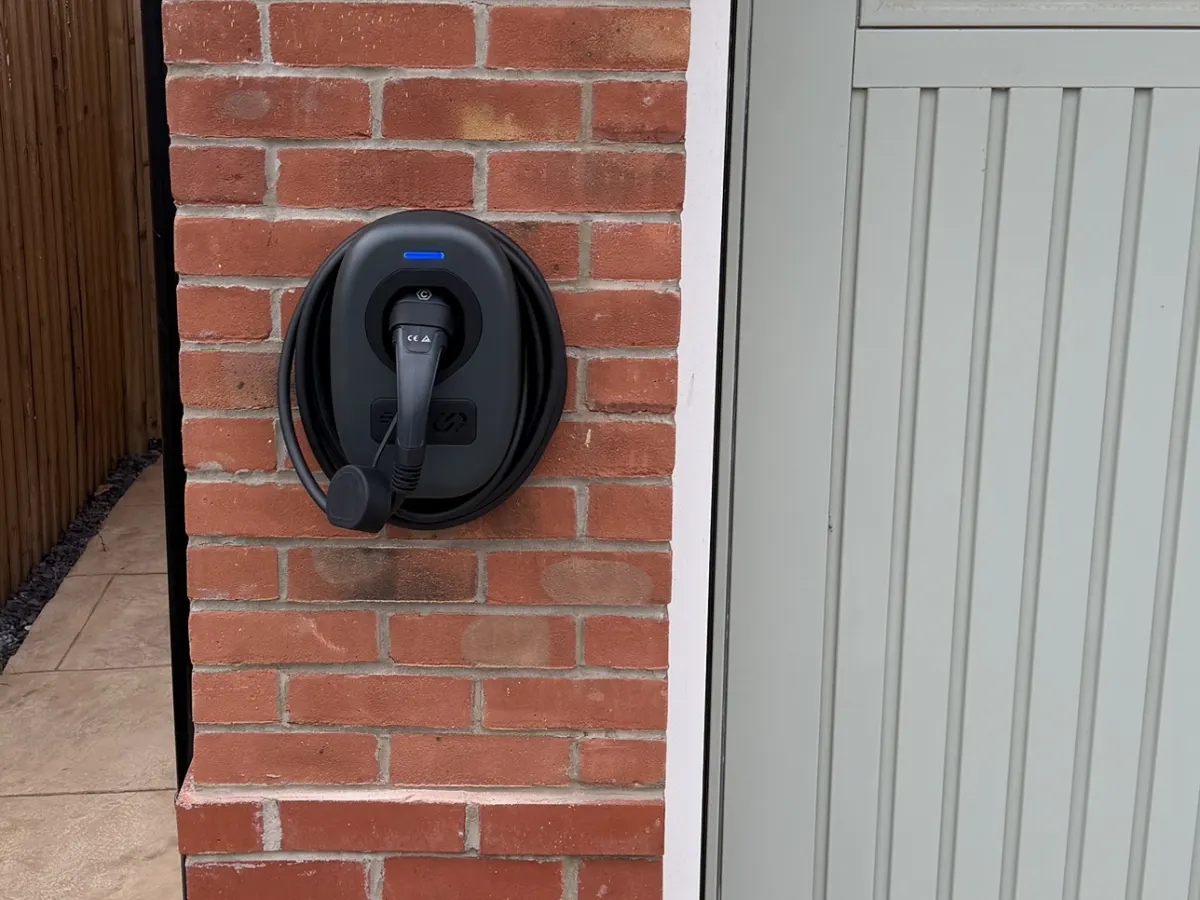
A home charger is the cheapest and easiest way to charge: you plug in when you get home and the car is ready in the morning. It's fixed to a wall or post by your parking space and gives up to 7.4kW on an ordinary home supply, about three times a 3-pin plug.
- 01Plug inIf the charger has its own cable (tethered), plug it into your car. If it has a socket, plug your own cable into the charger and the car.
- 02Let it charge, or schedule itSet the car or the charger's app to charge in your tariff's cheap hours. On a smart tariff such as Intelligent Octopus Go, you set when you need the car ready and the supplier schedules it.
- 03UnplugWhen you need the car, unplug it and put the cable away.
You need off-street parking (a driveway, a garage or your own space in a car park), or street parking outside your home and a permanent channel across the pavement (see below). A standard installation costs about £900 to £1,300 on our estimates; see home charger installation. Renters and flat owners with their own parking can get 75% off, up to £500, until 31 March 2027: the EV charger grant.
Which tariff: the best EV tariffs. Which charger: the best home chargers.
Charging from a 3-pin plug

You can charge from an ordinary 3-pin socket with a portable charger (often called a granny charger): a charging cable with a 3-pin plug and a control box. It charges at about 2.3kW at 10 amps, so a 10-hour night draws about 23kWh: up to about 80 miles in a car that does 3.5 miles per kWh, a little less after the energy lost as heat.
That's enough for a plug-in hybrid, low mileage, or a backup. But Electrical Safety First advises avoiding standard sockets: charging is a long, heavy load, likely to be more than an ordinary socket and its wiring are designed for. It recommends sockets made for EV charging (marked BS1363/EV) on their own circuit. If you do use a socket, get an electrician to check it first, and plug straight into the wall: never use an extension lead.
Our portable chargers work out how long yours would take.
No driveway? Charging near home
Many drivers without off-street parking charge at public chargers near home: on-street posts and lamp-post chargers, supermarket and leisure centre car parks, or a rapid hub for a quick top-up. Look on a charging map such as Zapmap for the chargers on your street and on your regular trips.
If the street outside your home is your only parking, the government's on-street grant pays 75% of a home charger, up to £500, until 31 March 2027. You need an eligible car and a permanent channel to take the cable across the pavement, with your highways authority's permission. Cable covers and mats don't count.
Charging at work
If your employer has chargers, you can charge while you work. Free charging at or near your workplace isn't a taxable benefit, as long as it's open to all the staff there and not offered through salary sacrifice.
Employers can get up to £500 a socket from the Workplace Charging Scheme. If yours hasn't fitted any, point them to business EV charging.
Using a public charger, step by step
There were 126,140 public EV chargers, on 98,899 charging units at 48,815 locations, across the UK at the end of October 2026. The steps are the same at almost all of them.
- 01Find a charger that fits your carUse a charging map or app, and filter by your car's connector. Most cars use Type 2 for slower AC charging and CCS for rapid charging; a few older cars, notably earlier Nissan Leafs, use CHAdeMO for rapid charging.
- 02Check the priceA public charger that charges for power has to show its price clearly in pence per kWh.
- 03Plug inRapid and ultra-rapid chargers always have their own cable. Most slower ones have a socket, so you use your own Type 2 cable. Push the plug firmly into the car until it clicks.
- 04Start the chargeTap a contactless bank card on the reader, or start it in the network's app or with a charging card. Contactless is required on new paid public chargers of 8kW and above put in after 24 November 2024, and on all paid chargers of 50kW and above. Card payments can hold a sum on your account until the charge is finished.
- 05Stop and unplugStop the charge with the same card or app, unlock the car, unplug, and put the charger's cable back. On a rapid charger, stopping at about 80% saves time: the last 20% is much slower.
Public charging costs more than charging at home: in October 2026 the average pay-as-you-go price was 54p per kWh on slower chargers and 82p on rapid ones. See the cost to charge an electric car.
Networks, apps and charging cards: our guide to public charging.
How an EV charger works: AC and DC
Your battery stores DC electricity, but the grid supplies AC. A home charger or a slower public charger passes AC to the car, and the car's on-board charger converts it, so that sets the top speed (the charger and cable can limit it too). A rapid charger converts the power itself and sends DC straight to the battery.
Before any power flows, the charger and the car check the connection, so the cable isn't live until it's plugged in properly. That's why it's safe to use a home or public charger in the rain.
| Connector | Used for | Who has it |
|---|---|---|
| Type 2 (seven pins) | AC: home chargers and slower public chargers, up to 22kW | Most cars |
| CCS (Type 2 with two extra DC pins) | DC: rapid and ultra-rapid chargers | Most cars |
| CHAdeMO | DC: rapid chargers | A few older cars, notably earlier Nissan Leafs |
| Type 1 (five pins) | AC, up to 7.4kW | A few older cars, such as older Nissan Leafs |
Need a cable for public chargers? Type 2 charging cables.
How long it takes
It depends on the charger, your car and how much you add. GOV.UK's rough guide times for a standard car battery (your planner result above is for your own miles):
| Charger | Power | Time |
|---|---|---|
| Standard | 3kW to 7kW | 3 to 8 hours |
| Fast | 7kW to 22kW | 1 to 3 hours |
| Rapid | 50kW and above | 20 to 40 minutes |
| Ultra-rapid | 100kW and above | 15 to 30 minutes |
Your car charges at the slowest of three things: the charger, the cable, and what the car can take. On AC, most new cars take up to 11kW, so a 22kW public charger won't charge them faster than 11kW. Cold batteries charge slower, and rapid charging slows down above 80%.
Tips for your first charges
- Practise near home first, on the networks you plan to use, before a long trip.
- Top up before the battery drops below about 20%, and stop rapid charges at about 80%.
- Learn where your charging port is and how your car's charge limit and timer work: both are in the handbook and usually on the car's screen or app.
- If a charge won't start, push the plug fully home, lock the car, and try again.
- Carry a Type 2 cable for slower public chargers; rapid chargers have their own.
Common questions
Get a free home charger quote
Charging at home overnight is the cheapest way to run an electric car. A local installer will be in touch with a free quote. No obligation.
How we checked this
Every figure and rule on this page was checked against its source on 14 November 2026. We recheck them every month.
- Charging electric vehicles (Energy Saving Trust, official; read 14 November 2026)
- Connecting electric vehicle chargepoints to the electricity network (GOV.UK (DESNZ), official; read 14 November 2026)
- EV charging statistics (Zapmap, industry; read 14 November 2026)
- A beginner's guide to charging an electric vehicle (Zapmap, industry; read 14 November 2026)
- The complete UK guide to EV charger connector types (Zapmap, industry; read 14 November 2026)
- Do I need my own charging cable? (Zapmap, industry; read 13 November 2026)
- Zapmap Price Index (Zapmap, industry; read 15 November 2026)
- Regulations: public charge points (GOV.UK (OPSS and OZEV), official; read 14 November 2026)
- Public Charge Point Regulations 2023 guidance (GOV.UK (OZEV), official; read 14 November 2026)
- The Public Charge Point Regulations 2023, regulation 1: extent (legislation.gov.uk, official; read 14 November 2026)
- Electric vehicle chargepoint grant for renters or flat owners (GOV.UK, official; read 14 November 2026)
- Electric vehicles: safety advice (Electrical Safety First, official; read 13 November 2026)
- Charging your business's electric vehicles (Energy Saving Trust, official; read 14 November 2026)
- Fleet decarbonisation toolkit: types of chargers (Energy Saving Trust, official; read 13 November 2026)
- EIM01035: charging facilities at or near the employee's workplace (HMRC, official; read 15 November 2026)
- Workplace Charging Scheme (GOV.UK Find a grant (OZEV), official; read 15 November 2026)
- Electric Vehicle Chargepoint Grant for Households with On-Street Parking (GOV.UK Find a grant, official; read 14 November 2026)
- Electric vehicle chargepoint grants (GOV.UK (OZEV), official; read 14 November 2026)
- Intelligent Octopus Go (Octopus Energy, industry; read 15 November 2026)
- Energy price cap unit rates and standing charges (Ofgem, official; read 15 November 2026)
Niko Moustoukas
Founder, Director · Drives a Tesla Model 3
Niko founded Power EV alongside EV Charge Cable, building both sites to cover the full home-charging picture: finding a qualified installer and getting the right cable for your car. The idea came from his own experience going through the process of getting a home charger fitted and realising how hard it was to find clear, unbiased information.
Meet the team